Hardware Engineering: Overcoming the Ignition Challenge
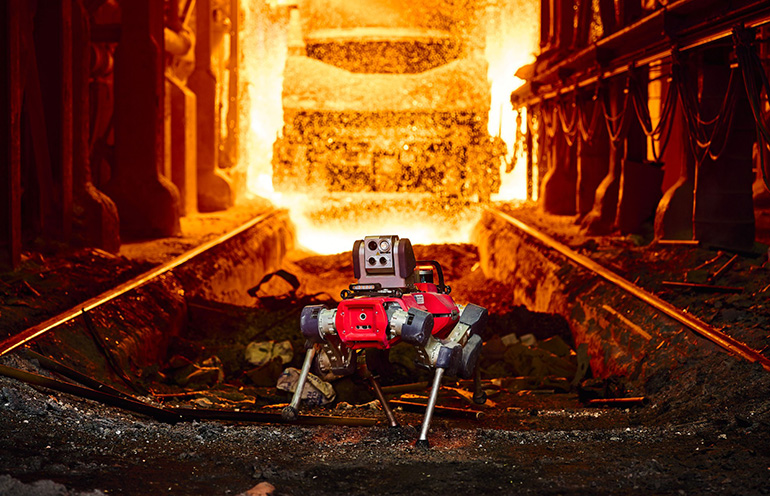
The delivery of the first ANYmal X units by ANYbotics marks a watershed moment in heavy industrial robotics. Unlike conventional robots, the ANYmal X was engineered under stringent safety protocols to operate in explosive atmospheres (Zone 1), where the presence of flammable gases or vapors is a constant risk. The core technological breakthrough lies in its ATEX and IECEx certification, which requires every electronic and mechanical component to be isolated such that no spark or thermal buildup can act as an ignition source.
Quadrupedal locomotion is the pillar of its mobility. While wheeled or tracked systems encounter insurmountable obstacles in refineries and offshore platforms—such as steep stairs, uneven surfaces, and narrow passages—the ANYmal X utilizes advanced force-control algorithms and computer vision to navigate with millimeter precision. The hardware consists of high-torque actuators and a sealed chassis that not only protects against explosions but also resists saline corrosion and industrial dust, ensuring an extended operational lifespan in extreme conditions.
Industrial Applications: Automation in High-Risk Zones
In the real world, the application of this technology focuses on human risk mitigation and operational optimization. Sectors such as oil and gas, petrochemicals, and chemical processing rely on frequent inspections to prevent catastrophic failures. Traditionally, these tasks require human technicians to enter hazardous areas, often necessitating production shutdowns to ensure team safety. The ANYmal X shifts this dynamic by enabling autonomous, continuous inspections without the need for operational downtime.
Equipped with a sophisticated sensor suite, including thermal cameras, gas detection sensors, ultrasonic microphones for leak detection, and LiDAR for 3D mapping, the robot acts as a mobile data collection node. It is capable of reading pressure gauges, verifying the thermal integrity of piping, and identifying acoustic anomalies in rotating machinery. This data is integrated in real-time into Digital Twin systems, allowing engineers to make evidence-based decisions without leaving the control room, thereby elevating the standard of predictive maintenance in Industry 4.0.
The Next Leap: Cognitive Autonomy and Swarm Integration
Despite the success in hardware certification, the next major hurdle for ANYmal X and similar technologies lies in total cognitive autonomy within unstructured environments. Currently, while the robot can follow pre-programmed routes and bypass dynamic obstacles, complex semantic interpretation of the environment remains a challenge. The immediate evolutionary step involves enhancing Edge AI, allowing the robot to not only detect a problem but also diagnose its severity and prioritize actions independently.
Furthermore, the evolution toward autonomous swarm systems represents the future of inspection robotics. Coordinating multiple ANYmal X units working in unison would allow for the coverage of vast industrial facilities in a fraction of the current time. For this to occur, advancements in decentralized communication protocols and battery energy density are fundamental. The transition from a passive inspection robot to an active intervention agent—capable of manipulating valves or performing minor repairs—is the final frontier that will definitively transform global critical infrastructure.
- Via: ANYbotics begins delivering ANYmal X legged robot for explosive atmospheres – The Robot Report.
About the Editorial Team
QOrigin Editorial is the science journalism core of QOrigin News, dedicated to transforming frontier academic research into in-depth analyses on quantum computing, physics, space exploration, and advanced systems architecture.