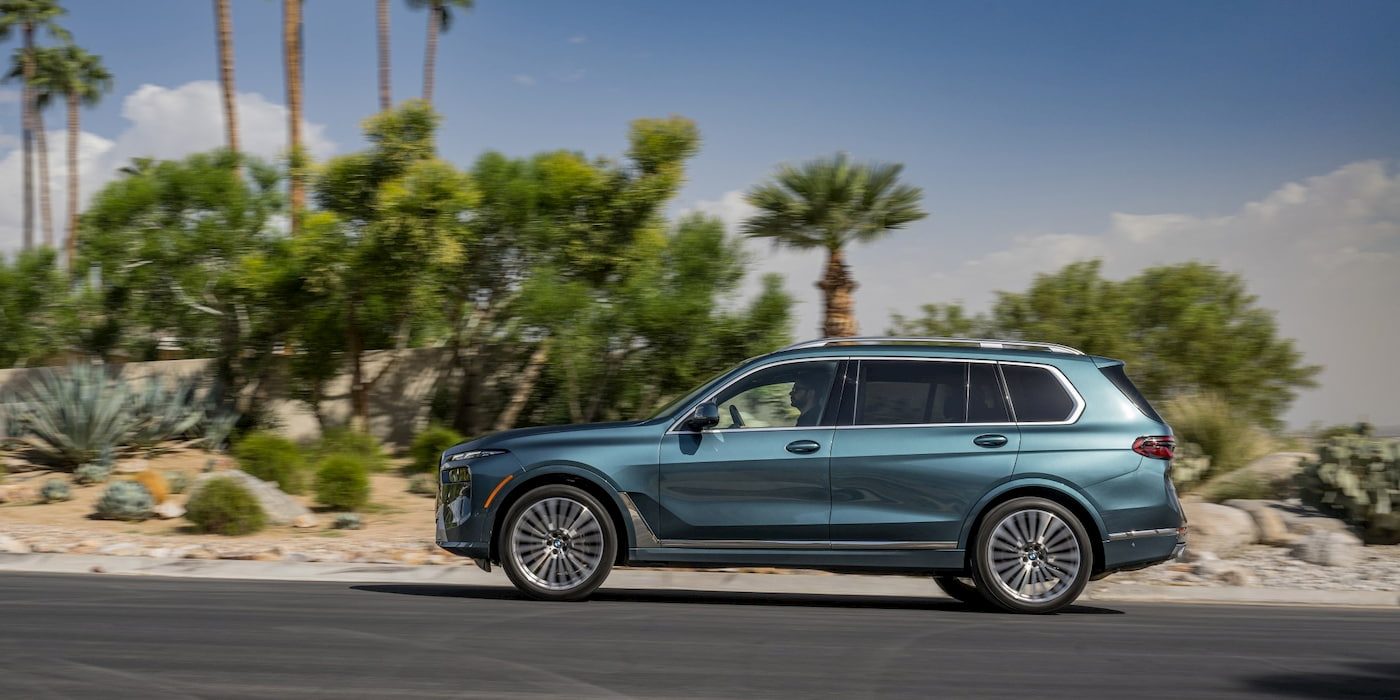
The confirmation of the BMW iX7 for 2027 marks a turning point not only for the Bavarian manufacturer’s portfolio but for the engineering of large-scale electric vehicles (EVs). Positioned as the pinnacle of luxury and technical capability, the iX7 will not merely be a stretched version of the current iX. It represents the maturity of BMW’s transition to dedicated architectures, focusing on unprecedented volumetric efficiency and energy density in three-row SUVs.
Structural Innovation and the Gen6 Cylindrical Cell Revolution
The core of the iX7’s innovation lies in the implementation of BMW’s sixth-generation (Gen6) battery cells. Abandoning the prismatic format in favor of cylindrical cells with a standard 46-millimeter diameter, BMW projects a 20% leap in volumetric energy density. For a vehicle the size of the iX7, which requires a high-capacity battery (estimated above 100 kWh) to maintain competitive range, this shift is crucial.
The transition to an 800-volt system is another fundamental engineering pillar. This architecture allows for significantly higher charging currents, reducing the 10% to 80% recharge time to under 30 minutes, even in massive battery packs. Furthermore, the smaller gauge wiring permitted by high voltage reduces the overall weight of the electrical harness, a critical factor in mitigating the inherent mass of a seven-seater SUV. Structural battery integration (pack-to-chassis) is also expected to increase the vehicle’s torsional rigidity, improving driving dynamics and passive safety.
Supply Chain Reconfiguration and Market Positioning
The decision to launch the iX7 profoundly alters the dynamics of BMW’s global supply chain. The production of the new cylindrical cells requires strategic partnerships with suppliers such as CATL and EVE Energy, which are building gigafactories near BMW’s assembly centers, including the Spartanburg plant in the US. This move aims to reduce the logistical carbon footprint and mitigate geopolitical risks in the supply chain of critical minerals like lithium and cobalt.
In the market, the iX7 emerges to fill a technical gap against the Mercedes-Benz EQS SUV and the Rivian R1S. While competitors focus on extreme aerodynamics or off-road capabilities, BMW bets on the integration of software and hardware. The iX7 will be among the first to utilize BMW’s new ‘super-brain’—a centralized computing unit that replaces dozens of individual ECUs (Electronic Control Units). This simplifies the electronic architecture and allows for much deeper Over-the-Air (OTA) updates, affecting everything from battery thermal management to adaptive suspension algorithms.
Future Perspectives: Autonomous Driving and Thermal Efficiency
Looking toward 2027 and beyond, the iX7 will serve as the ultimate testbed for Level 3 autonomous driving systems. The integration of solid-state LiDAR sensors and AI processing redundancy will allow the vehicle to operate autonomously on highways under specific conditions, raising the standard for active safety. Software engineering will be the differentiator, using machine learning models to predict energy consumption based on topography and real-time traffic.
Another expected advancement is the refinement of the heat pump system and predictive thermal management. In three-row vehicles, the cabin volume to be climatized is vast, which traditionally drains the battery severely. The iX7 is expected to introduce a more efficient system for recovering waste heat from electronic components and motors, ensuring that thermal comfort does not compromise long-range autonomy. The iX7 is not just an SUV; it is BMW’s manifesto that large-scale electrification can coexist with precision engineering and absolute luxury.
- Via: BMW is going upscale with its first 3-row EV, the iX7 – Electrek.
About the Editorial Team
QOrigin Editorial is the science journalism core of QOrigin News, dedicated to transforming frontier academic research into in-depth analyses on quantum computing, physics, space exploration, and advanced systems architecture.