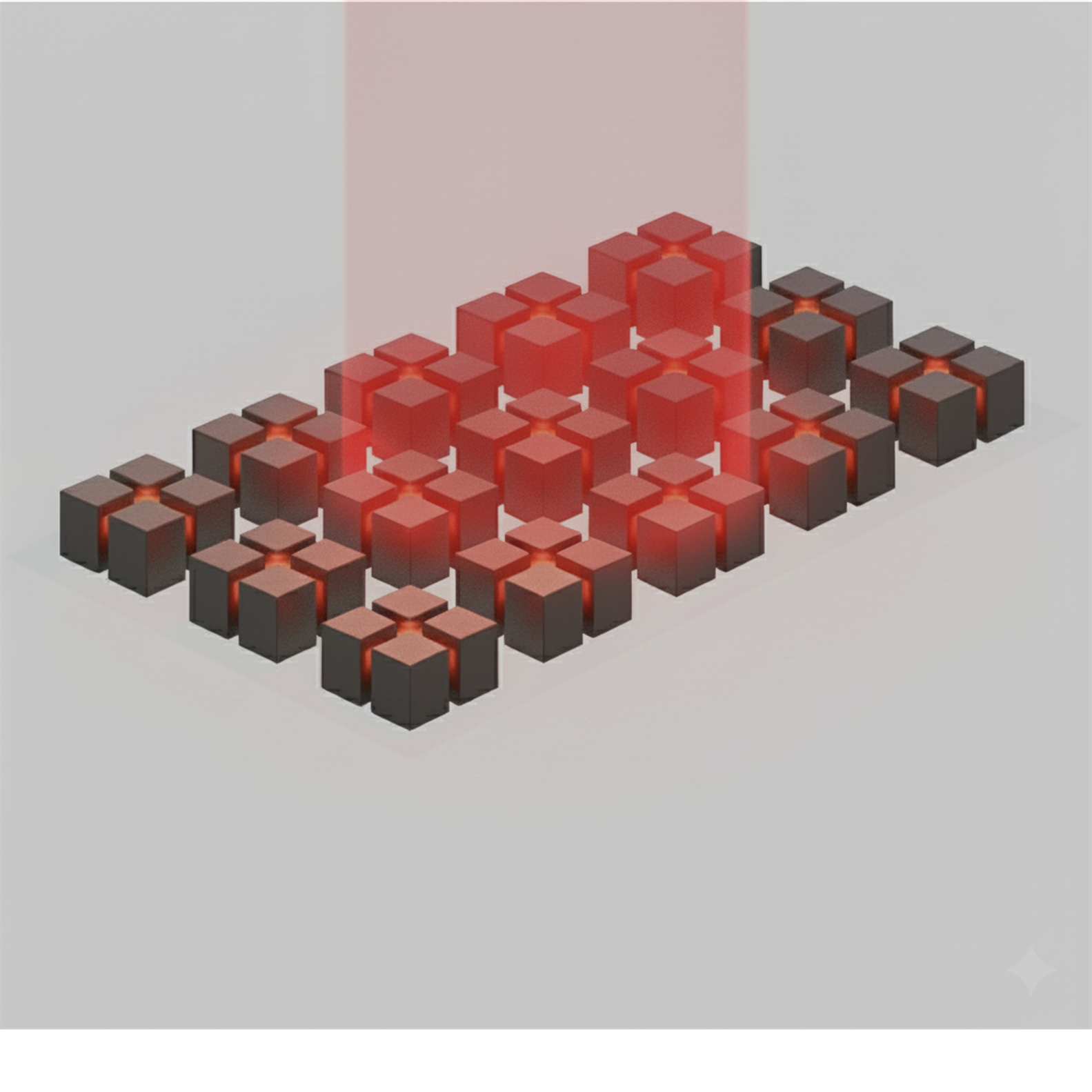
The optical industry is undergoing a historic transition, moving away from bulky and heavy components in favor of nanoscale solutions. At the heart of this revolution are dielectric metasurfaces—ultrathin structures capable of manipulating the amplitude, phase, and polarization of light with unprecedented precision. Recently, breakthroughs led by Dr. Pavel Terekhov at the National Institute of Standards and Technology (NIST) have demonstrated how engineering multipole resonances is transforming what was once academic theory into a robust industrial design strategy for sensing, energy harvesting, and flat optics.
The End of Bulk Optics and the Metasurface Solution
Traditionally, light control relied on glass lenses or crystals that occupy significant space and add weight to devices. While metallic (plasmonic) metasurfaces emerged as an early alternative, they suffer from high energy losses due to the intrinsic absorption of metals. The launch of methodologies based on dielectric materials, such as silicon and gallium nitride, solves this fundamental problem. These materials offer extremely low losses and allow for refined control over how light interacts with matter.
The featured innovation focuses on the ability to design specific multipole resonances. By using semianalytical multipole decomposition integrated with COMSOL Multiphysics software, engineers can now predict and tune how a single “meta-atom”—the basic unit of the metasurface—behaves. This solves the problem of unpredictability at the nanoscale, allowing the industry to manufacture surfaces that can absorb, reflect, or transmit light on demand, which is essential for computer vision technologies and high-speed optical communications.
From Simulation to Production: The Multipole Decomposition Bridge
The transition from the experimental phase to commercial production in nanotechnology requires repeatability and clear design rules. The NIST work demonstrates that full-wave simulation, when combined with multipole analysis, allows researchers to identify the exact physical origin of a resonance. For example, by arranging silicon quadrumers into a periodic crystalline lattice, an anomalous enhancement in absorption was observed, governed by two independent multipole mechanisms coexisting in the same structure.
This ability to “sculpt” the optical spectrum was pushed further using gallium nitride (GaN), where the complex interplay of four different multipoles is used to manipulate quasi-bound states in the continuum (q-BIC). These q-BIC states are crucial for creating ultra-high-resolution optical filters and low-power lasers. By turning abstract resonance behaviors into interpretable design rules, the technology moves from the pure physics lab to the semiconductor assembly line, leveraging manufacturing processes already established in the microchip industry.
Economic Impact and the Future of the Photonics Market
The economic impact of this technology is vast, with the potential to redefine sectors ranging from medicine to energy infrastructure. In the sensor market, dielectric metasurfaces enable the creation of portable and extremely sensitive diagnostic devices, reducing healthcare costs and increasing accessibility. In the energy sector, the ability to optimize light absorption could lead to a new generation of much more efficient and lightweight photovoltaic cells, capable of operating in low-light conditions.
Furthermore, global communications infrastructure stands to benefit from the downsizing of fiber optic components and increased bandwidth through precise polarization control. It is estimated that replacing traditional optical components with metasurfaces will reduce hardware costs in consumer electronic devices, such as smartphones and augmented reality headsets, making them thinner and more energy-efficient. In the long term, the standardization of these multipole-based design strategies establishes a new foundation for technological sovereignty in nanomanufacturing, consolidating photonics as the pillar of 21st-century computing and communication.
Official Announcement / Industry: Engineering Multipole Resonances in Dielectric Metasurfaces for Transmission, Reflection, and Absorption Control via IEEE Spectrum.
About the Editorial Team
QOrigin Editorial is the science journalism core of QOrigin News, dedicated to transforming frontier academic research into in-depth analyses on quantum computing, physics, space exploration, and advanced systems architecture.