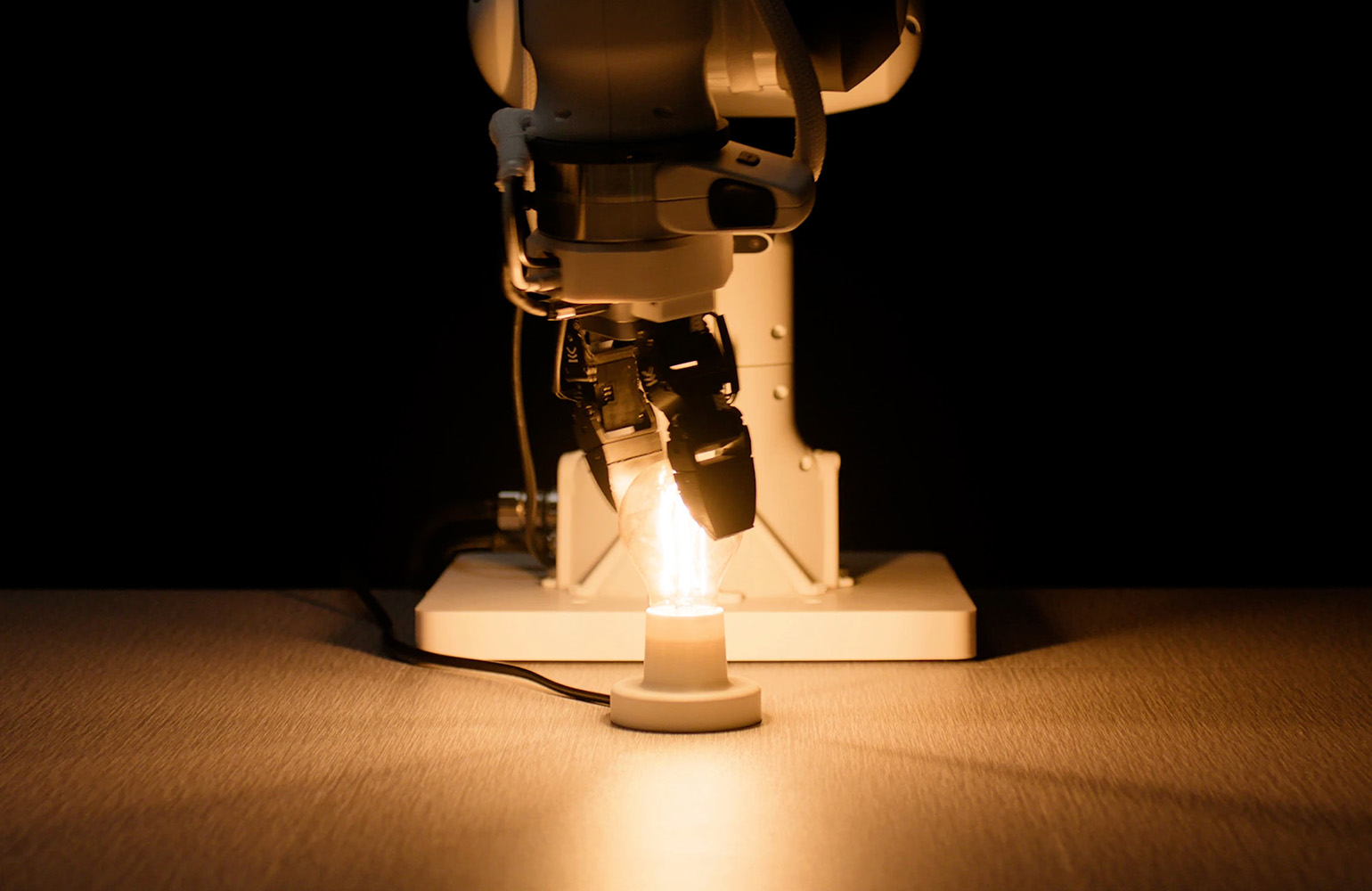
Contemporary robotics is undergoing a fundamental paradigm shift, moving away from systems purely based on computer vision toward architectures that understand the physics of contact. The recent announcement that Eka Robotics raised $150 million to scale its Vision-Force-Action (VFA) model marks a turning point in the quest for robots that possess what engineers call “physical intuition.” This advancement is not merely an incremental hardware improvement but a redefinition of how artificial intelligence processes interaction with the material world.
The Technical Breakthrough: The Vision-Force-Action Paradigm
The core of Eka Robotics’ innovation lies in the deep integration between visual perception and real-time force feedback. Traditionally, robots operate under a “see and act” regime, where a camera identifies an object and the robotic arm executes a pre-programmed or calculated trajectory. However, this approach fails in tasks requiring delicacy or adaptation to unpredictable materials, such as soft tissues or mechanical components with minimal tolerances.
The VFA model utilizes Reinforcement Learning at a massive scale to train neural networks that not only recognize an object’s geometry but anticipate resistance, friction, and mass. By merging torque sensor data from joints with high-fidelity video streams, Eka’s system develops a latent representation of physics. This allows the robot to “feel” if a fit is correct or if the pressure applied to a surface is excessive, mimicking human fine motor coordination. The hardware, while robust, serves as the peripheral nervous system for a digital brain that has learned to navigate Newton’s laws through millions of simulations and real-world interactions.
Real-World Applications: From Heavy Industry to Exploration
The implications of this technology are vast and touch critical sectors of the global economy. In heavy industrial automation, the VFA model enables robots to perform complex assemblies that were previously exclusive to human operators, such as wiring electrical panels or handling deformable aerospace parts. The ability to dynamically adjust force reduces material waste and increases safety in environments where machines and humans collaborate closely.
In the healthcare sector, Eka Robotics’ technology opens doors for advanced telesurgery and robotic assistance in long-term care. VFA-equipped robots can interact with patients safely, applying the exact pressure needed for physical support without causing injury. Furthermore, in space and underwater exploration, where environmental conditions are extreme and unpredictable, physical intuition allows autonomous probes to manipulate geological samples or repair infrastructure without the need for constant commands from Earth, overcoming communication latency delays.
The Next Hurdle: Generalization and the Data Bottleneck
Despite the significant financial backing and the initial success of the VFA model, the next major challenge for Eka Robotics is universal generalization. Currently, most robotic AI models perform exceptionally well in controlled environments or on specific tasks for which they were trained. The “Holy Grail” of robotics is the creation of a foundation model that can be transferred to any manipulation task without additional training.
The evolutionary obstacle lies in the scarcity of high-quality data on force interactions. While Large Language Models (LLMs) can be trained on vast internet text repositories, “force-action” data must be generated physically or in ultra-realistic physics simulators that still struggle to perfectly replicate real-world friction and fluid dynamics. Overcoming the so-called “sim-to-real gap”—the discrepancy between simulation and reality—will require not only more computational power but new methods of self-supervised learning where robots can continuously learn from every interaction, turning every tactile error into a software update for the entire global fleet.
- Via: Eka Robotics raises $150M to scale its vision-force-action model for robots – The Robot Report.
About the Editorial Team
QOrigin Editorial is the science journalism core of QOrigin News, dedicated to transforming frontier academic research into in-depth analyses on quantum computing, physics, space exploration, and advanced systems architecture.