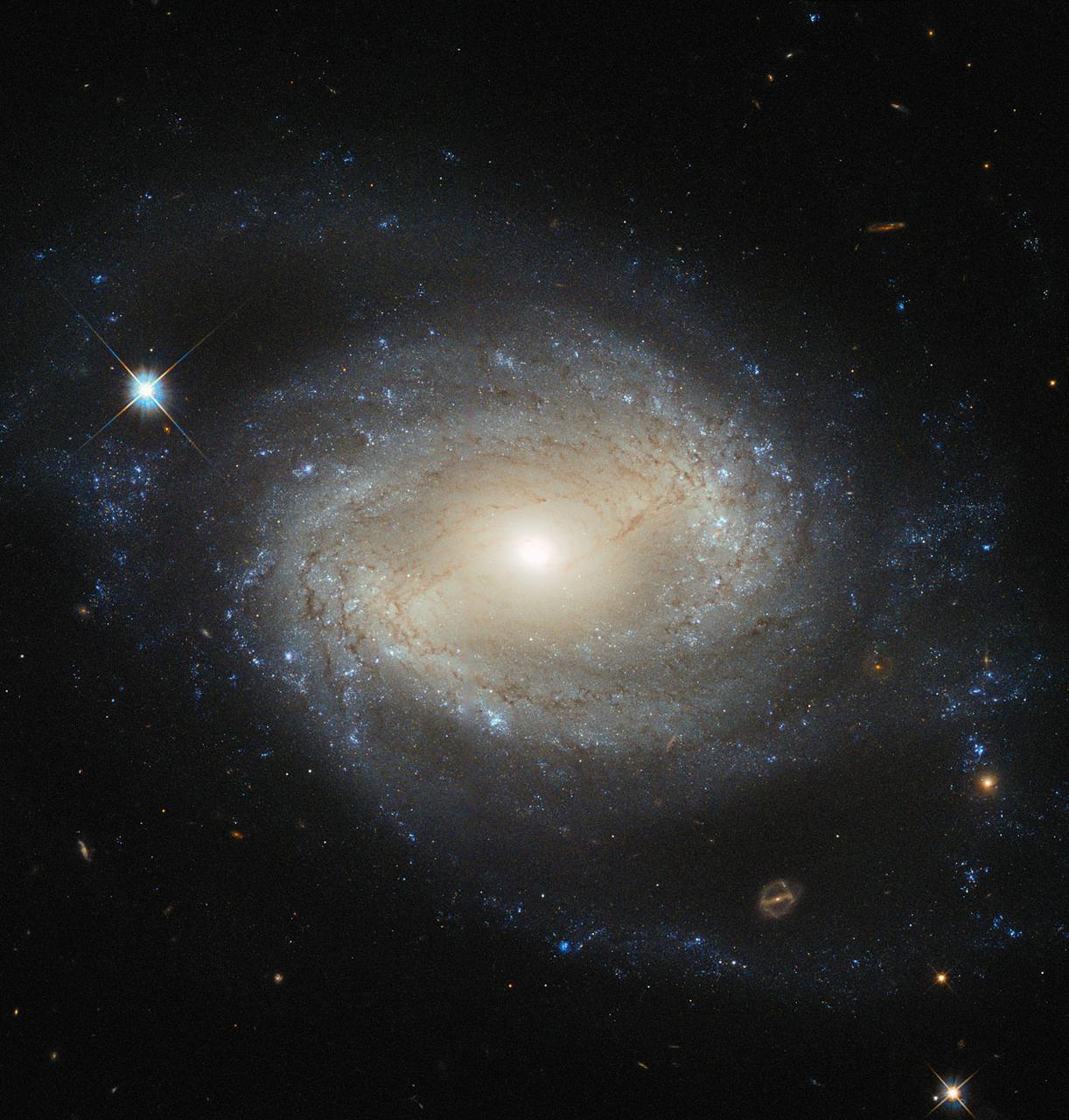
The Forest that Records Cosmic History
The light traveling from distant quasars — extremely bright galactic nuclei powered by supermassive black holes — to our telescopes carries the scars of its billion-year journey. As it passes through clouds of neutral hydrogen scattered throughout the intergalactic medium (IGM), this light undergoes specific absorptions at determined wavelengths, creating a pattern of spectral lines known as the “Lyman-alpha forest.” For contemporary cosmologists, this pattern acts as a cosmic barcode revealing the density, temperature, and composition of the early universe. However, the further back in time we look — specifically toward the era known as the “Cosmic Dawn” — the harder it becomes to read this information accurately.
The High-Redshift Hurdle
At high redshifts, such as , the task of measuring the 1D power spectrum, mathematically denoted as , becomes a true statistical nightmare. Molly Wolfson and her fellow researchers point out that at this remote stage of cosmic history, the universe was just beginning to emerge from the Epoch of Reionization. The intergalactic gas was significantly more opaque, meaning a much smaller fraction of quasar light could reach our instruments. Beyond natural opacity, the scarcity of sufficiently bright light sources and the omnipresence of instrumental noise make traditional methods, based on the classic Fourier Transform, increasingly inaccurate and prone to systematic errors.
Moving Beyond the Fourier Transform
The conventional approach to calculating relies heavily on continuous, uniform, and high-quality data. However, real observations of high-redshift quasars are often fragmented by missing data and distorted by the finite resolution of modern spectrographs. To address this impasse, the team led by Molly Wolfson, Joseph F. Hennawi, Frederick B. Davies, and Zarija Lukić developed and validated a likelihood-based estimator.
Unlike the Fourier Transform, which attempts to decompose the signal directly into spatial frequencies, the new method constructs a complex covariance matrix at the pixel level. According to the researchers, this matrix incorporates precomputed -space integrals that rigorously account for instrumental resolution and pixel sampling. This enables direct maximum-likelihood inference, making the statistical process much more resilient to data gaps and the background noise that typically invalidates simpler analyses.
Validation and Experimental Results
To prove the effectiveness and robustness of the new estimator, the group utilized what they call “mock spectra” — state-of-the-art computer simulations that mimic real astronomical observation conditions. They tested the method under rigorous scenarios, including models incorporating ultraviolet background fluctuations and the chaotic final stages of cosmic reionization. The study compared the results obtained by the new estimator against traditional Fourier methods and the known input parameters of the simulations.
The results were impressive. The likelihood-based estimator successfully recovered the input power spectrum across all tested scales, remaining consistently within expected statistical error margins. More importantly, it proved immune to the observational effects that typically “blind” other methods, such as irregular pixel sampling and the low signal-to-noise ratios typical of such distant objects.
Impact on Cosmology and Dark Matter
The significance of this work extends far beyond pure statistics or signal processing. By providing a more precise and nearly optimal tool for measuring Lyman-alpha forest clustering, Wolfson and her team pave the way for answering fundamental questions about the nature of dark matter. For instance, if dark matter is of the “warm” variety rather than “cold,” it would leave a distinct and subtle mark on the power spectrum at smaller scales — something that can now be measured with unprecedented confidence.
Furthermore, the method is crucial for understanding the timeline of how the universe became transparent. Large-scale fluctuations detected by the estimator can reveal how the first stars and galaxies ionized the primordial hydrogen that filled the vacuum. With the arrival of new large-scale telescopes and the execution of massive quasar surveys, this new mathematical framework positions itself as the gold standard for deciphering the final secrets of our cosmos’s infancy.
Scientific Source: A Robust Estimator for the Lyman- Forest 1D Power Spectrum at High Redshift — Authors: Molly Wolfson, Joseph F. Hennawi, Frederick B. Davies, Zarija Lukić. Available on arXiv.
About the Editorial Team
QOrigin Editorial is the science journalism core of QOrigin News, dedicated to transforming frontier academic research into in-depth analyses on quantum computing, physics, space exploration, and advanced systems architecture.