The Shift Toward Decentralized Multi-Agent Systems
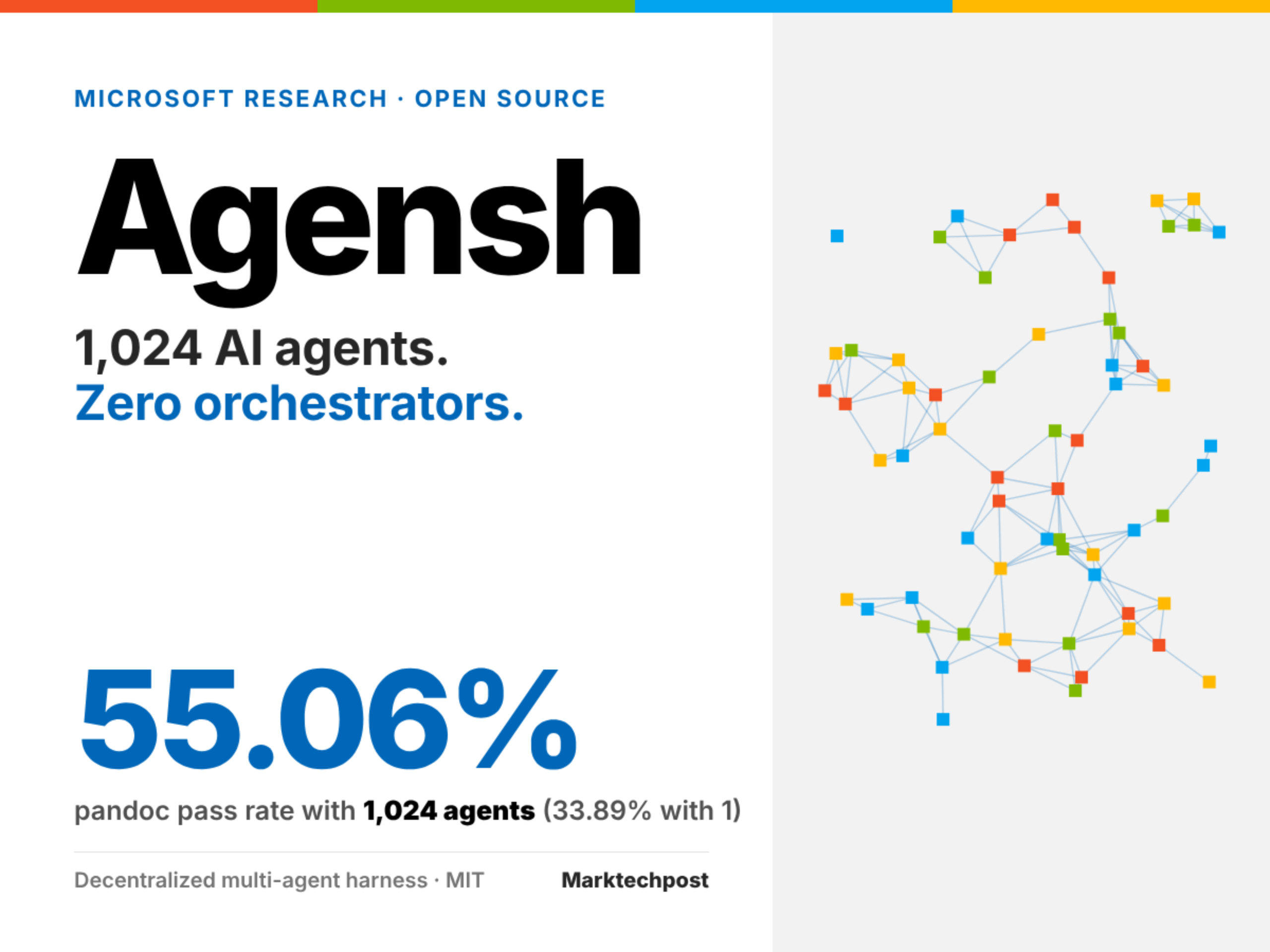
Microsoft Research has achieved a significant milestone in the field of collective artificial intelligence with the open-source release of Agensh. This new framework, described as a multi-agent “harness,” challenges current AI system conventions by enabling the coordination of up to 1,024 simultaneous agents without the need for a centralized orchestrator. While most current Multi-Agent Systems (MAS) architectures rely on a “hub-and-spoke” model—where a master agent distributes tasks and consolidates results—Agensh introduces a self-organizing approach inspired by human software engineering workflows.
This innovation arrives at a time when the industry is seeking to overcome the context and reasoning limitations of individual models. By distributing the workload across hundreds or thousands of specialized agents, Agensh allows large-scale problems, which would be intractable for a single Large Language Model (LLM), to be decomposed and solved in a parallel and collaborative manner.
Architectural Innovation: Shared Environments Without Central Control
The core technical differentiator of Agensh lies in its communication architecture and shared environment. In traditional systems, the central orchestrator often becomes a cognitive and computational bottleneck; it must process all interactions, which inherently limits scalability. Agensh eliminates this figure, replacing it with an ecosystem of self-organizing workers that interact through three fundamental pillars: a shared Git repository, a chat channel, and a findings board.
In this model, agents do not wait for direct orders. They monitor the Git repository to understand the current state of the code, use the chat to align strategies, and consult the findings board to avoid redundant efforts. This structure mimics a real-world agile development environment. The absence of rigid central control allows the system to scale linearly, maintaining efficiency even as the number of agents increases from a dozen to over a thousand. Research demonstrates that this decentralization reduces decision latency and increases system resilience, as the failure of a single agent does not compromise the integrity of the entire operation.
Benchmarking Success: ProgramBench and the 1,024-Agent Scale
To validate the effectiveness of Agensh, Microsoft Research utilized ProgramBench, a rigorous benchmark designed to test programming capabilities and complex problem-solving. The results were impressive: the framework successfully managed a swarm of 1,024 agents under a strict six-hour time constraint. This time limit is crucial, as it demonstrates that Agensh is not only capable of solving problems but doing so with an operational efficiency that justifies the computational cost.
During testing, it was observed that the self-organizing capability allowed agents to identify code dependencies autonomously. They were able to perform refactoring, debugging, and the implementation of new features in parallel, integrating changes via Git in a coherent manner. The ability to scale to 1,024 agents sets a precedent for the automation of infrastructure and development tasks that previously required months of coordinated human effort.
Practical Impact: Redefining Software Engineering and Autonomous Workflows
The impact of Agensh for programmers and the technology industry is profound. For developers, the tool signals a paradigm shift: from being “code writers” to becoming “AI swarm managers.” Instead of manually implementing every function, a software engineer can define high-level objectives and oversee how Agensh distributes execution among hundreds of specialized agents.
In the industry, the applications are vast. Companies with large legacy codebases can utilize Agensh to perform massive technological migrations or security audits in record time. Furthermore, the open-source nature of the project allows the AI research community to explore new forms of neural collaboration, potentially applying Agensh’s principles to fields beyond programming, such as complex scientific simulations, global logistics, and real-time data analysis. Agensh is not merely a productivity tool; it is a prototype of what the digital workforce of the future might look like—where intelligence does not reside in a single giant model, but in the efficient collaboration of a vast network of specialized agents.
- Via: Microsoft Open-Sources Agensh: A Multi-Agent Harness for 1,024 Agents – MarkTechPost.
About the Editorial Team
QOrigin Editorial is the science journalism core of QOrigin News, dedicated to transforming frontier academic research into in-depth analyses on quantum computing, physics, space exploration, and advanced systems architecture.