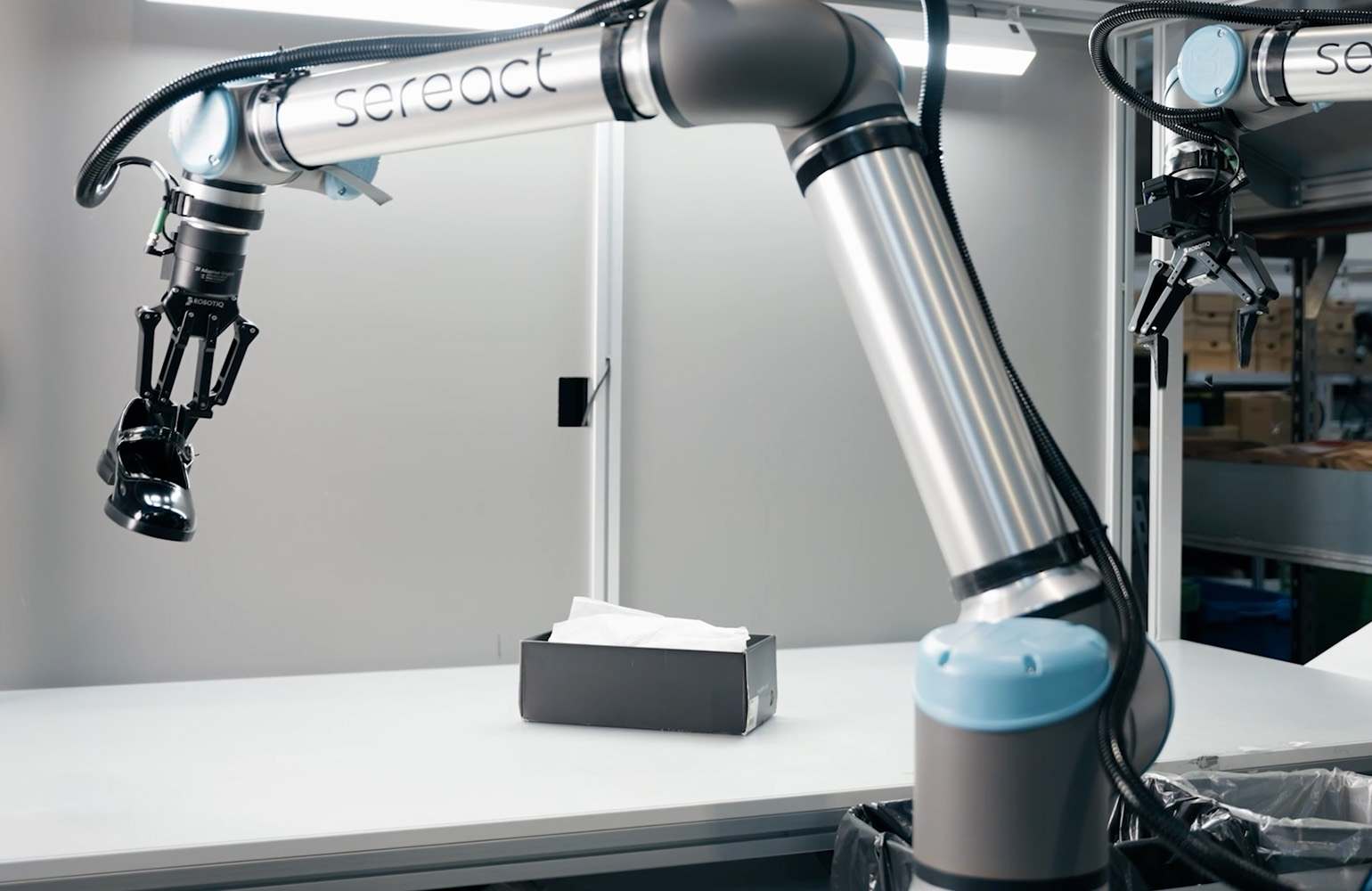
The boundary between purely digital artificial intelligence and mechanical manipulation is rapidly dissolving. The recent partnership between Teradyne Robotics—the parent company of Universal Robots (UR) and Mobile Industrial Robots (MiR)—and Sereact, a pioneering German AI software startup, represents a fundamental milestone in the implementation of “Physical AI.” Unlike traditional automation, which relies on pre-programmed trajectories and highly controlled environments, this collaboration focuses on the ability of robots to perceive, reason, and act within dynamic and unpredictable scenarios, such as retail and heavy logistics sectors.
Hardware Advancement and Physical AI Integration
The technical core of this evolution lies in the integration of transformer models (similar to those powering ChatGPT) directly into the kinematic control of collaborative robotic arms (cobots). Teradyne’s hardware, specifically the dual-arm systems from Universal Robots, provides the necessary precision and repeatability, while Sereact’s software acts as the system’s cerebral cortex.
The breakthrough is not merely mechanical but resides in the control architecture. Traditionally, a robot would require thousands of lines of code to identify and manipulate a new object. With Sereact’s technology, the system utilizes advanced computer vision and natural language processing to understand complex instructions and identify objects without specific prior training. The dual-arm configuration allows for bimanual coordination that mimics human ergonomics, enabling the manipulation of bulky, fragile, or irregularly shaped items that would be impossible for a single-gripper system. This synergy between robust hardware and deep neural networks allows the robot to perform pick-and-place operations with a drastically reduced error rate, even under varying lighting conditions or visual clutter.
Real-World Applications: Logistics and Beyond
The practical implementation of this technology has already moved past the laboratory testing phase. Hundreds of these dual-arm systems have already been shipped to logistics and retail centers across Europe. In the e-commerce sector, where the variety of SKUs (Stock Keeping Units) is infinite, the adaptability of Physical AI is revolutionary. Robots can unload pallets, sort orders, and pack products with an efficiency that rivals human labor, but with the advantage of 24/7 uninterrupted operation.
Beyond logistics, the impact extends to advanced manufacturing and exploration. In heavy industrial environments, a robot’s ability to “understand” the physical state of a part—such as its texture, weight, and center of gravity—through torque sensors and vision, allows for precision assembly without the need for expensive custom jigs. In healthcare, while still in early stages, autonomous bimanual manipulation logic opens doors for hospital pharmacy automation and even assistance in complex laboratory procedures where human contamination must be avoided at all costs.
The Next Evolutionary Step: Generalization and Tactile Sensing
Despite the success of large-scale deployment in Europe, the next major hurdle for Teradyne and Sereact is total generalization and advanced tactile sensory integration. Currently, most Physical AI systems rely heavily on vision. However, to achieve the dexterity of a full humanoid, robots require “electronic skin” or high-fidelity force-torque sensors that allow for real-time fine-tuning of pressure without relying solely on visual feedback.
The subsequent evolutionary step will be the transition from fixed-arm systems to fully autonomous mobile platforms that combine bimanual manipulation with locomotion in unstructured environments. The ultimate goal is the creation of a universal robotic operating system, where Physical AI does not need to be tweaked for every new task but instead learns through observation and continuous interaction with the physical world. The Teradyne-Sereact partnership is the foundation for an era where robotics will cease to be a niche tool and become the invisible, intelligent infrastructure of the global economy.
- Via: Teradyne Robotics partners with Sereact to scale physical AI in retail and logistics – The Robot Report.
About the Editorial Team
QOrigin Editorial is the science journalism core of QOrigin News, dedicated to transforming frontier academic research into in-depth analyses on quantum computing, physics, space exploration, and advanced systems architecture.