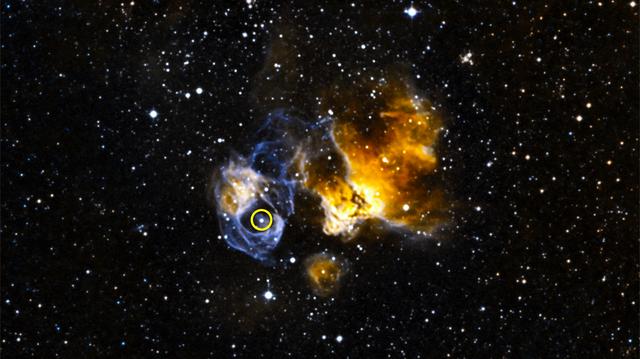
Deep within the molecular clouds where massive stars are born, exotic phenomena act as beacons for astronomers. One of the most fascinating is the methanol maser—a natural, microwave version of a laser. Recently, a study by S. P. van den Heever and D. J. van der Walt has shed new light on the brightest 6.7 GHz methanol maser in the Milky Way, located in the high-mass star-forming region G009.62+0.20E. Through a rigorous analysis of two decades of observations, the researchers have isolated the physical mechanism driving this object’s rhythmic behavior, dismissing several theories that had persisted for years.
The Enigma of Cosmic Pulsations
The G9.62+0.20E region is renowned for exhibiting periodic variations in its brightness, known as maser flares, detected at both 6.7 GHz and 12.2 GHz. For a long time, the scientific community debated what caused this precise periodicity. Hypotheses were diverse: ranging from unstable accretion of matter onto the forming star and spiral shocks in circumbinary disks to complex quantum phenomena like Dicke’s superradiance. However, the lack of long-term data prevented a definitive conclusion on which physical model best described reality.
S. P. van den Heever and D. J. van der Walt decided to tackle this challenge by analyzing time series spanning approximately 20 years of monitoring. The focus was on the stability and repeatability of these flares. If the mechanism were chaotic, such as matter accretion, the flares should show significant variations in shape and interval over time. If it were a geometric and orbital mechanism, precision would be the hallmark.
Methodology and Mathematical Precision
To extract order from cosmic noise, the authors employed advanced statistical methods, such as Lomb-Scargle (LS) and Phase Dispersion Minimization (PDM). These tools allowed them to determine that the period of the methanol maser flares at both frequencies is approximately 243.0 +- 0.3 days.
Once the period was established, the team applied a phase-folding technique, which overlays all observed cycles into a single representative graph. The result was striking: the flares are highly repeatable and stable. The shape of the flare profile and its duty cycle remained almost identical over the span of 8,000 days. To validate this consistency, the researchers used a replicated Kernel Density Estimator (KDE), which successfully reproduced the historical time series with impressive fidelity.
The Verdict: Colliding Stellar Winds
The detailed analysis allowed S. P. van den Heever and D. J. van der Walt to systematically eliminate almost all previously proposed models. The extreme stability of the flare profiles is incompatible with the stochastic nature of periodic accretion or the volatility of shocks in dust disks. Dicke’s superradiance and intrinsic stellar pulsations also failed to explain the longevity and specific shape of the observed signal.
The only model that withstood scrutiny was the Colliding Wind Binary (CWB) model. In this scenario, two massive stars orbit a common center. As they move, their powerful stellar winds collide, creating a shock region that modulates the background radiation or alters the physical conditions of the gas where the maser is amplified. The CWB model not only survived statistical testing but also qualitatively explained why the flare profile is so persistent: it is dictated by celestial orbital mechanics, which are inherently stable.
Impact on High-Mass Astronomy
The discovery by S. P. van den Heever and D. J. van der Walt has profound implications for our understanding of how the most massive stars in the universe form. High-mass stars rarely born alone; they usually emerge in multiple systems. Confirming that G9.62+0.20E is governed by a binary system through maser analysis offers a new tool to study the dynamics of these systems at stages where dust still hides the visible light of the stars.
Furthermore, the study sets a new standard for long-term monitoring in radio astronomy. It demonstrates that observational patience, combined with cutting-edge data analysis techniques, can solve mysteries that isolated observations never could. The “methanol clock” of G9.62+0.20E now serves as a testbed for the physics of stellar winds and binary evolution, helping to map the life cycle of the giants that shape galaxies.
Scientific Source: Insights from the stability of methanol maser flare properties I: G9.62+0.20E — Authors: S. P. van den Heever, D. J. van der Walt. Available on arXiv.
About the Editorial Team
QOrigin Editorial is the science journalism core of QOrigin News, dedicated to transforming frontier academic research into in-depth analyses on quantum computing, physics, space exploration, and advanced systems architecture.