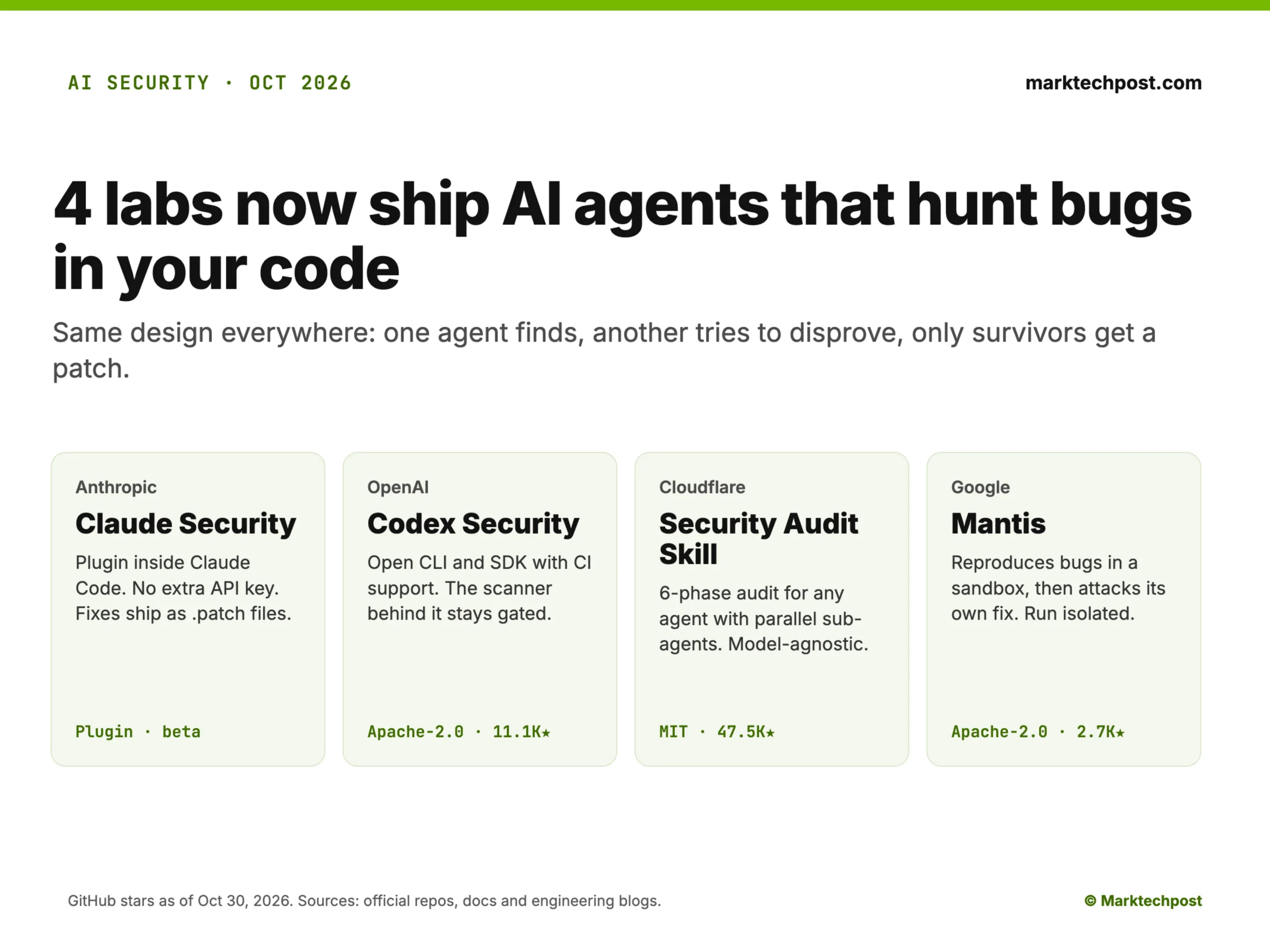
The software security industry is undergoing a fundamental paradigm shift. The emergence of Artificial Intelligence (AI) agents specifically designed for vulnerability discovery and remediation marks the transition from passive static analysis tools to autonomous systems capable of complex reasoning. Recently, Anthropic, OpenAI, Google, and Cloudflare introduced their respective solutions, each utilizing Large Language Models (LLMs) to close the loop between bug detection and its definitive fix.
The Innovation: The Autonomous Find-Disprove-Patch Loop
The major innovation lies not just in the ability to identify flaws, but in the implementation of an iterative loop known as “Find, Disprove, then Patch.” Traditionally, SAST (Static Application Security Testing) tools generated a massive volume of false positives, overwhelming security teams. New AI agents, however, use reasoning capabilities to attempt to “disprove” the found vulnerability. If the agent cannot prove the flaw is harmless through simulations or context analysis, it assumes the risk is real and proceeds to generate a patch.
This approach drastically reduces analytical noise. Unlike legacy tools that rely on code pattern signatures, these agents use neural networks to understand the semantics and logic of data flow, allowing for the identification of complex logical vulnerabilities that previously required exhaustive human auditing.
Comparative Architectures: Technical Differentiators
While sharing the same goal, the architectures vary significantly. Claude (Anthropic) stands out for its expanded context window and emphasis on constitutional AI, making it particularly effective at analyzing entire repositories to understand cross-dependencies. Meanwhile, Codex/o1 (OpenAI) focuses on Chain-of-Thought reasoning, allowing the agent to plan multiple exploration steps before suggesting a fix.
Google’s Mantis integrates deeply with the company’s infrastructure ecosystem, focusing on cloud vulnerabilities and misconfigurations that can lead to large-scale data breaches. Finally, Cloudflare’s solution operates at the edge, attempting to intercept and mitigate exploits in real-time while the vulnerable code is still being patched in the backend. Beyond these four giants, the market is seeing the rise of tools like Greptile and Sweep, which focus on the continuous maintenance of security technical debt.
Practical Impact and the Future of Development
For the industry, the immediate impact is the acceleration of the Software Development Life Cycle (SDLC). Developers now have a “security reviewer” working in real-time, suggesting fixes even before the code is submitted for a pull request. This democratizes cybersecurity, allowing small companies that lack the resources to hire large Red Teaming teams to maintain enterprise-level security standards.
For society, the automation of cyber defense is a necessary response to the increase in attacks also orchestrated by AI. However, an ethical and technical challenge arises: the arms race. As defense agents become more sophisticated, attack agents (offensive AI) also evolve. The effectiveness of these tools will depend on the models’ ability to avoid hallucinations—situations where the AI suggests a patch that, while appearing correct, introduces a new vulnerability or breaks system functionality. The future of cybersecurity will no longer be about who has the best firewall, but about who possesses the AI agent with the most precise and rapid reasoning.
- Via: AI Security Agents Compared: Claude, Codex, Mantis, Cloudflare – MarkTechPost.
About the Editorial Team
QOrigin Editorial is the science journalism core of QOrigin News, dedicated to transforming frontier academic research into in-depth analyses on quantum computing, physics, space exploration, and advanced systems architecture.