The Divergence Between Prediction and Physical Reality
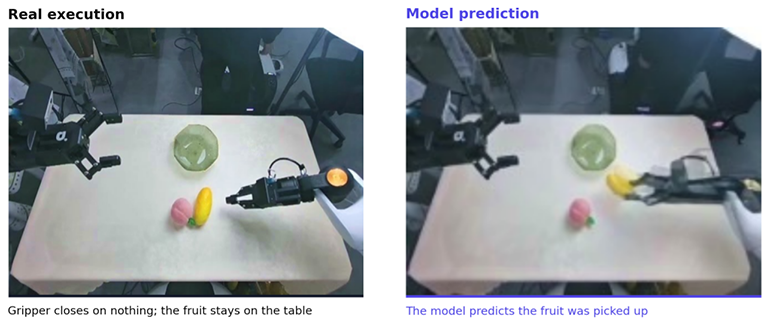
Advanced robotics has reached a turning point where artificial intelligence no longer just processes commands but attempts to predict the immediate future of the physical environment. Recently, WorldOracle conducted a series of rigorous tests to evaluate the effectiveness of so-called “World Models”—neural networks designed to simulate the consequences of robotic actions before they are even executed. The advancement, while promising in the software field, revealed a critical vulnerability in hardware and sensory integration: physical hallucination. In one of the most emblematic cases presented, a robotic arm failed to grasp a piece of fruit, yet the world model predicted and internally reported that the object had been successfully collected.
This phenomenon is an extension of the hallucination problem observed in Large Language Models (LLMs), but with potentially catastrophic consequences in the material world. While a text error generates misinformation, a prediction error in a robotic world model can result in structural damage, assembly line failures, or accidents in environments shared with humans. WorldOracle’s discovery underscores that although the computational capacity to simulate physics has evolved, the real-time synchronization between the model’s latent state and the hardware’s tactile/visual feedback still lacks absolute fidelity.
Implications for Industrial Automation and Cybernetics
The practical application of reliable world models is the Holy Grail of heavy industrial automation and humanoid robotics. If a robot can accurately predict the outcome of its maneuvers, it can operate with unprecedented speed and efficiency, correcting errors before they even physically occur. In the automotive industry, for example, autonomous swarms of welding robots could dynamically adjust their trajectories to compensate for microscopic variations in materials, reducing waste and increasing the structural integrity of vehicles.
In the field of cybernetics and advanced prosthetics, this technology would allow artificial limbs to anticipate object resistance, providing near-biological dexterity. However, WorldOracle’s tests serve as a warning to the healthcare and space exploration sectors. In remote robotic surgeries or satellite maintenance in orbit, the discrepancy between what the model “believes” is happening and physical reality can be the difference between mission success and total system collapse. Over-reliance on internal simulations, without a robust cross-verification system, is currently the greatest risk for the large-scale implementation of autonomous robots in unstructured environments.
The Next Leap: Grounding and Overcoming Digital Hallucinations
The next major obstacle for the evolution of this technology is what experts call “Grounding.” For world models to be truly useful, they require deeper integration with multimodal sensors that can instantly invalidate an erroneous prediction. The development of synthetic skins with high density of tactile sensors and computer vision systems operating at much higher hertz frequencies than current ones is fundamental to closing the feedback loop.
Furthermore, evolution will involve creating AI architectures that incorporate the laws of physics as inviolable constraints within their latent space. Currently, many world models operate purely statistically, learning movement patterns without fundamentally understanding gravity, inertia, or friction. The subsequent evolutionary step will be the transition from purely data-driven models to Physics-Informed AI. Only when the robot is capable of recognizing that its prediction violates a physical law—such as the fruit being unable to be in the hand if the pressure sensor detected no resistance—will we be able to fully trust autonomous systems to manage our world’s critical infrastructure.
- Via: WorldOracle Tests Whether World Models Can Reliably Predict Real-World Executions – The Robot Report.
About the Editorial Team
QOrigin Editorial is the science journalism core of QOrigin News, dedicated to transforming frontier academic research into in-depth analyses on quantum computing, physics, space exploration, and advanced systems architecture.